1937 Rudge Ulster Motorcycle
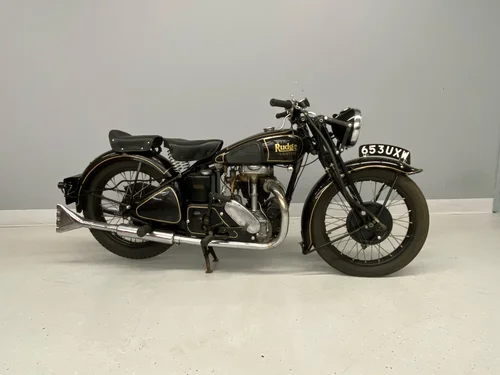
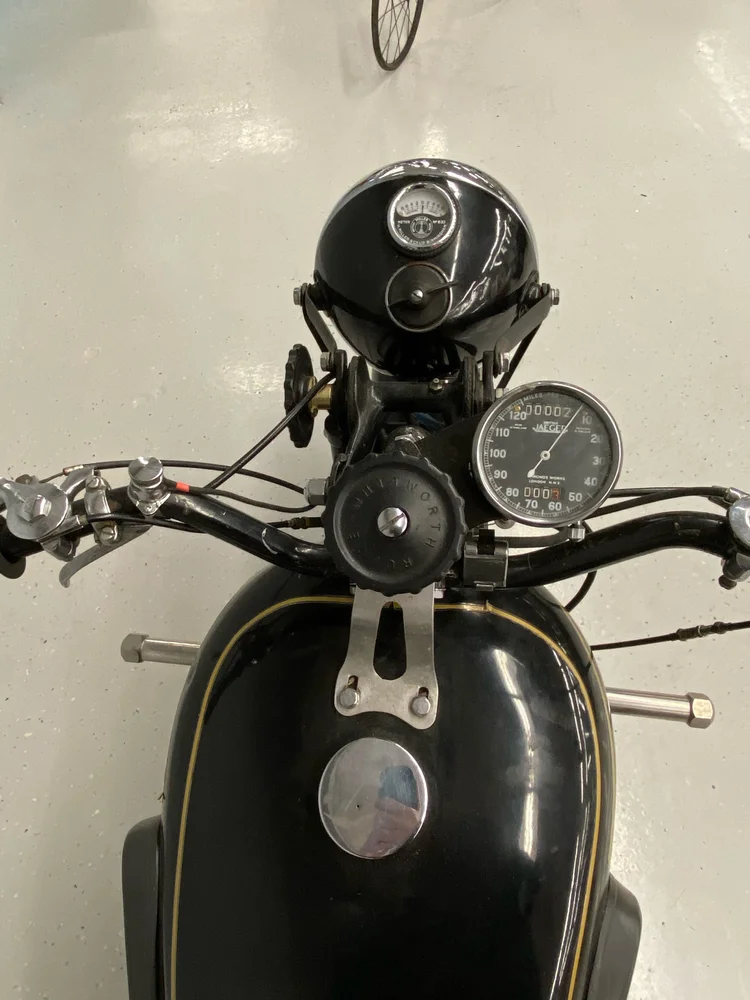
Advertised as “probably the fastest 500cc motorcycle in normal production”, the Rudge Ulster offered a level of comfort and refinement that was unmatched among high-performance motorcycles of the era. Distinguished from two lesser Rudge 500cc models, the ‘Special’ and the ‘Sports Special’, the ‘Ulster’ had an aluminum-bronze four-valve cylinder head with enclosed valve gear.
The Ulster was named after Rudge’s famous race win in the 1928 Ulster Grand Prix, which was won by Graham Walker, father of famed motor-racing commentator Murray Walker. The race was won at over 80mph – the first time any road-race had been won at this speed.
Although originally intended as a prototype racing motorcycle, it was offered for sale to the public and effectively became one of the first ‘race replicas’. The heart of Rudge performance was its single cylinder 500cc motor and unique ‘semi-radial’ cylinder head, which featured four valves operated by branched rocker arms and pushrods. This allowed higher engine speeds, while the bronze-alloy material used for the cylinder head provided superior thermal conductivity and improved cooling at the cost of a small weight penalty. Twin exhaust ports and a dual muffler system are fitted with ‘fishtail’ outlets to optimize performance and reduce noise.
The cycle parts were also revolutionary: the foot brake pedal operated both the front and rear brakes, with the handlebar brake lever also operating the front brake. An adjustable spring-loaded compensating device allowed the rider to change the front-to-rear brake balance. The large hand-lever on the rider’s left controls a patented main-stand operating device, used by Vincent a decade later.
In the 1920s and 30s, Rudge was a dominant force in motorcycle competition. In addition to Walker’s 1928 Ulster Grand Prix win, in the same year Ernie Nott secured the two-hour record at over 100mph, a spectacular achievement at the time. In the 1930 Isle of Man Senior TT, the Rudge team of Ernie Nott, Graham Walker, Henry Tyrell-Smith and Wal Handley (later of BSA Gold Star fame) won the Team Prize, with Handley winning outright at a record average race speed of 74.24 mph. In the same year, Tyrell-Smith went on to win the European 500cc Championship for Rudge.
With the economic downturn of the early 1930s, Rudge sales began to decline. In 1933 the dirt-track and TT race models were dropped from the range, focusing instead on road machines. In 1936 the company was sold to E.M.I. (Electric & Musical Industries) who closed the motorcycle factory in 1939 to focus on radar production during World War 2. Bicycle manufacturer Raleigh acquired the interests of Rudge-Whitworth in 1943 and continued to use the name on a range of bicycles. Norman Motorcycles bought the rights to motorcycle production in 1943 but only continued to build the low-cost 98cc Rudge Autocycle.
Specifications:
Engine: 499cc single-cylinder, air-cooled OHV
Gearbox: 4-speed manual
Top Speed: 90 mph
Efficiency: 60 mpg