1966 Ford GT40 MK1
Generously Lent by Johnny Shaugnessy
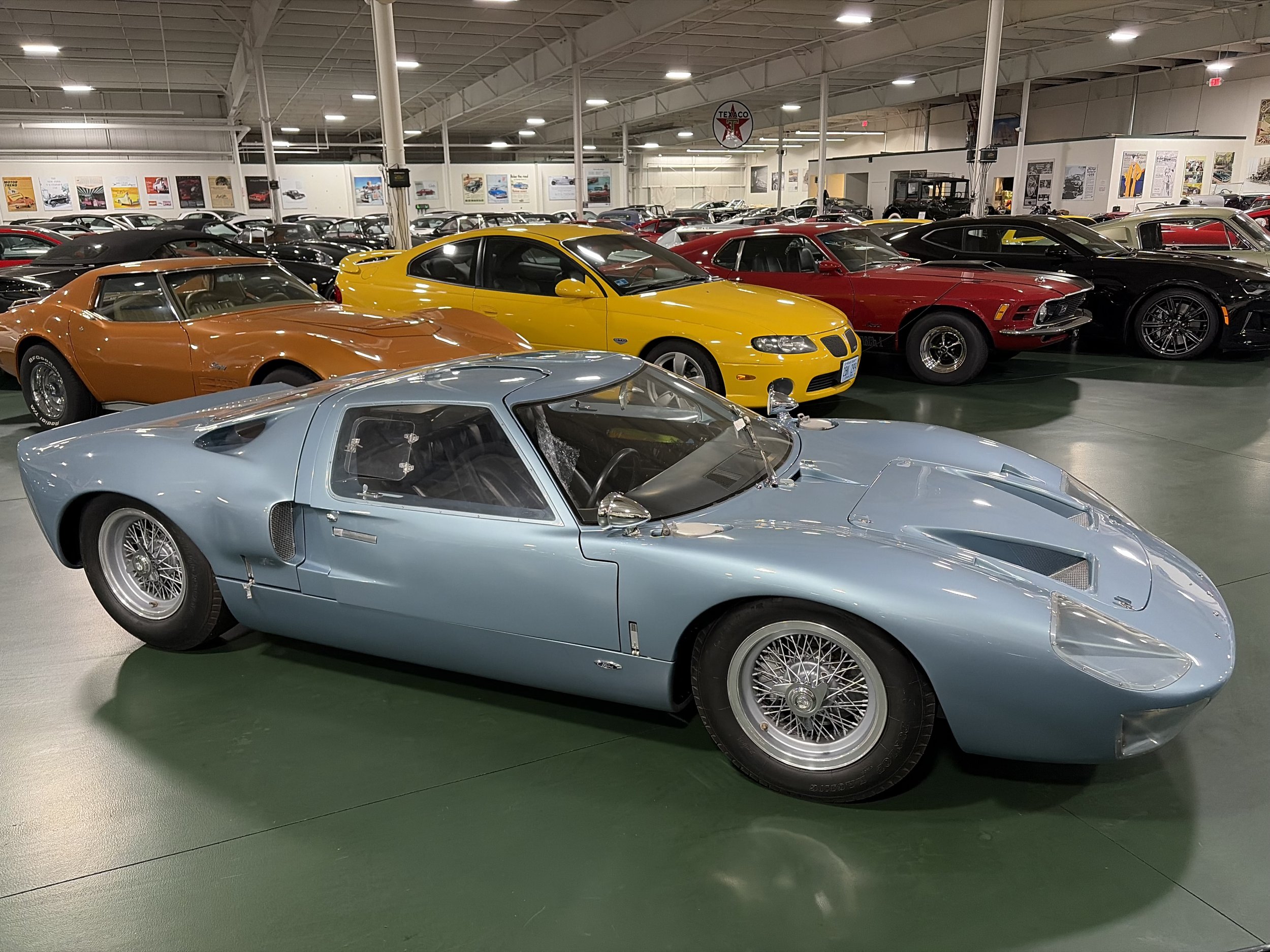
· 1 of only 30 road-legal Mk I coupes built, making this car extremely rare
· The GT40 name comes from its 40-inch roof height, below typical race car standards at the time
· The Mk I laid the foundation for Ford’s historic 1-2-3 finish at the 1966 24 Hours of Le Mans (though the Mk II was the outright winner that year).
This 1966 Ford GT40 Mk1 chassis P/1067 is considered the last 1966 car produced under Ford Advanced Vehicles. It is one of 30 Mk1 road car GT40's produced. It went on to be used as a pace car by Stirling Moss and James Garner in the 1967 Laguna Seca Can-Am race. After the succession of several owners the car found its way into storage in 1977 awaiting restoration. In 2014 the car was purchased by Janus Associates LLC and in 2017 a multiyear restoration was started by Canepa in Scotts Valley, CA. In 2021 the car was shown at Pebble Beach Concours d'Elegance after nearly 44 years of not being seen. Today the car is restored to how it left the Ford Slough Factory in 1966.
The 1966 Ford GT Mk I occupies a pivotal place in motorsport history as the car that helped Ford achieve its long-sought victory over Ferrari at the 24 Hours of Le Mans. Its origins trace back to the early 1960s, when Henry Ford II sought to elevate Ford’s global prestige through endurance racing. After a failed attempt to purchase Ferrari in 1963, Ford committed vast resources to beating the Italian marque on the world’s most prestigious endurance stage.
The Ford GT program began with the Lola Mk6, designed by Eric Broadley, which influenced the GT40’s chassis and layout. Named for its 40-inch overall height, the GT40 Mk I featured a steel monocoque chassis and mid-mounted V8 engine. Early versions struggled with reliability, aerodynamics, and high-speed stability at Le Mans, resulting in repeated retirements in 1964 and 1965 despite promising pace.
By 1966, extensive development—guided by Ford Advanced Vehicles in the UK and Carroll Shelby’s team in the United States—transformed the GT Mk I into a competitive and durable machine. The car was powered by a 4.7-liter (289 cubic inch) Ford V8, producing around 385 horsepower, paired with improved suspension, brakes, and cooling systems. While Ford also fielded the larger-engined Mk II, the Mk I remained an integral part of the overall strategy.
At the 1966 24 Hours of Le Mans, Ford achieved a historic 1-2-3 finish, marking the first overall Le Mans victory for an American manufacturer. Although the Mk II claimed first place, the Mk I’s strong performance and reliability underscored the success of the GT40 concept. In subsequent years, the Mk I continued racing in privateer hands, most notably winning Le Mans outright in 1968 and 1969 in Gulf-livery.
Specifications:
Engine: Mid-engine Ford V8 289 cu in with 4 Weber 48 IDA carburetors
Power: ~350–390 bhp (varies by tune and spec) at ~6,500–7,200 rpm
Torque: ~330 lb-ft (~447 Nm)
Transmission: 5-speed ZF 5DS-25 manual gearbox, rear wheel drive
Chassis: Semi-monocoque steel with square tube stiffening
Front Suspension: Independent double wishbones, coil springs, dampers, anti-roll bar
Rear Suspension: Independent, upper/lower arms with transverse link, coil springs, dampers, anti-roll bar
Brakes: Discs all-round
Body: Fiberglass panels
0–60 mph: ~5.3 seconds (varies by spec); ¼ Mile: ~11.8 seconds
Top Speed: 160–190 mph depending on gearing and tune
Weight: 2100 – 2,350 lbs